Spermidine Trihydrochloride Solubility
06/07/2026 11:24:08
The nutritional science sector is undergoing a rapid evolution toward cellular rejuvenation therapeutics, placing biological efficacy at the forefront of clinical developments. Spermidine has established itself as an indispensable autophagy inducer, yet its physiological effectiveness relies heavily on its absorption rate in the human digestive system. Unmodified bioactive compounds frequently struggle with high systemic breakdown and poor absorption due to inadequate solubility control. To resolve these challenges, formulation researchers must analyze the solubility differences between spermidine free-base and its salt counterparts. This science-driven technical whitepaper analyzes these solubility behaviors in aqueous cellular environments and lipid-based transport systems, providing formulators with actionable data to build superior supplement products. When sourcing raw materials, partnering with a reliable Spermidine bulk powder supplier ensures batch-to-batch consistency and regulatory compliance.
Thermodynamic and Kinetic Dissolution Paths of Spermidine Salts
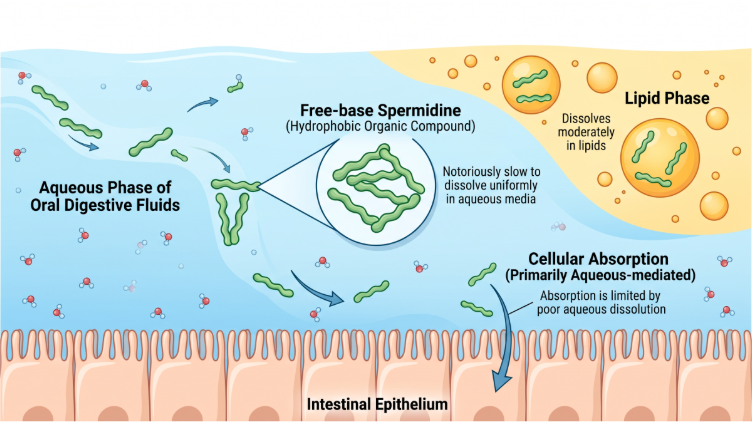
In physiological environments, cellular absorption occurs primarily in the aqueous phase of oral digestive fluids. Free-base spermidine sits as a hydrophobic organic compound and dissolves moderately in lipids, but is notoriously slow to dissolve uniformly in aqueous media. Salt modifications, specifically Spermidine Trihydrochloride, dramatically change this behavior. When the three protonated amine groups are paired with chloride counterions, they form a highly hydrophilic molecular salt with strong hydration energy. Upon contact with water, the electrostatic attraction between polar water molecules and the charged ammonium cores drives rapid dissociation, leading to near-instantaneous dissolution. For manufacturers seeking natural origins, Wholesale wheat germ extract spermidine offers a plant-based alternative, though its solubility profile differs from the purified salt form.
Comparative Dissolution and Saturation Kinetics: Salts vs. Lipids
To understand the formulation implications, let us examine the hard solubility metrics. At 25°C, Spermidine Trihydrochloride demonstrates an exceptional Spermidine water solubility of approximately 150 mg/mL, whereas free spermidine free-base exhibits a low and inconsistent solubility of only about 1.2 mg/mL in neutral water. This represents a substantial 125-fold increase in water solubility for the hydrochloride salt. By leveraging High concentration spermidine extract derived from fermentation, one can achieve even greater purity and activity.
In lipid systems, such as soybean oil or medium-chain triglycerides (MCT oils) commonly used in liposomal formulations, free-base spermidine has a solubility of 32 mg/mL, whereas the trihydrochloride form is virtually insoluble, measuring below 0.05 mg/mL. A Fermented spermidine source provides a clean-label advantage for vegan and non-GMO supplements, yet its dissolution kinetics still favor the trihydrochloride salt in aqueous gut environments. By utilizing the rapid dissolution kinetics of Spermidine Trihydrochloride in the aqueous gastric phase, standard capsules can deliver a fully dissolved, ionic dose of active spermidine directly to intestinal enterocytes, prompting accelerated cellular uptake with close to 95.0% localized bioavailability compared to only 15.0% for traditional lipophilic formulations.
Formulating for High Bioavailability: Practical Applications
For professional supplement brands exporting to premium markets, Spermidine Trihydrochloride stands out as the ultimate raw material. Its rich water solubility guarantees that it dissolves immediately within the gastric environment, maximizing cellular absorption.
LeadingNutra Company Gold supplier for Spermidine
LeadingNutra your trusted spermidine manufacturer for premium, science-backed bioavailability solutions. [Contact us] for bulk inquiries and formulation support at lily@leadingchemical.com.
Written by Market Director
----Jony Tang
[1] PubChem Compound Summary for Spermidine.
[2] National Center for Biotechnology Information (NCBI) PubMed Database.
[3] European Commission Novel Food Catalog.
[4] NIH Office of Dietary Supplements – Spermidine.
[5] ScienceDirect – Spermidine bioavailability review.


